

ICL Center

What is an ICL ?

An ICL is an additional lens implanted inside the eye to correct vision problems, allowing patients to live without relying on glasses.

It has been used for over 30 years, with more than 3 million patients worldwide.

The lens is made from Collamer, a special material containing collagen that is highly biocompatible with the eye—soft, clear, and designed to last long-term.

ICL is the preferred first-line option for vision correction in Japan, with its popularity continuing to grow worldwide.
Comparison Between ICL and LASIK
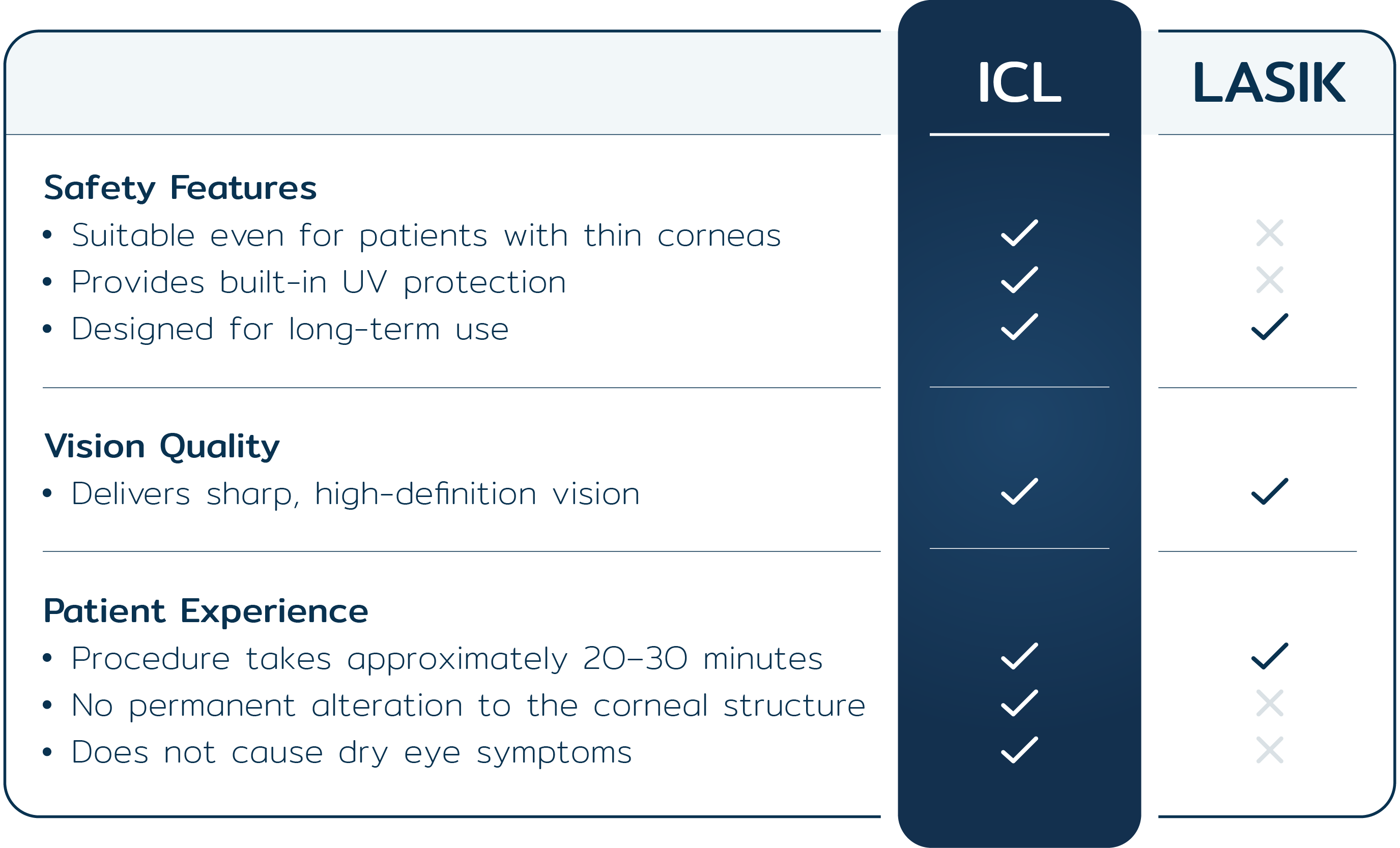
Who Is ICL Suitable For?
- Individuals aged 21 and above
- Those with nearsightedness from -0.75 up to -16.00 diopters, or astigmatism up to -6.00 diopters
- Patients with thin corneas or dry eyes, who may not be suitable for LASIK
- Individuals seeking the highest level of visual quality
Today, ICL is no longer just an alternative for those who cannot undergo LASIK. It has become a first-choice option for many patients who prioritize maximum safety, wish to avoid permanent changes to the corneal structure, and desire superior visual outcomes.

Safety & Technology
Pre-Procedure Evaluation Technology
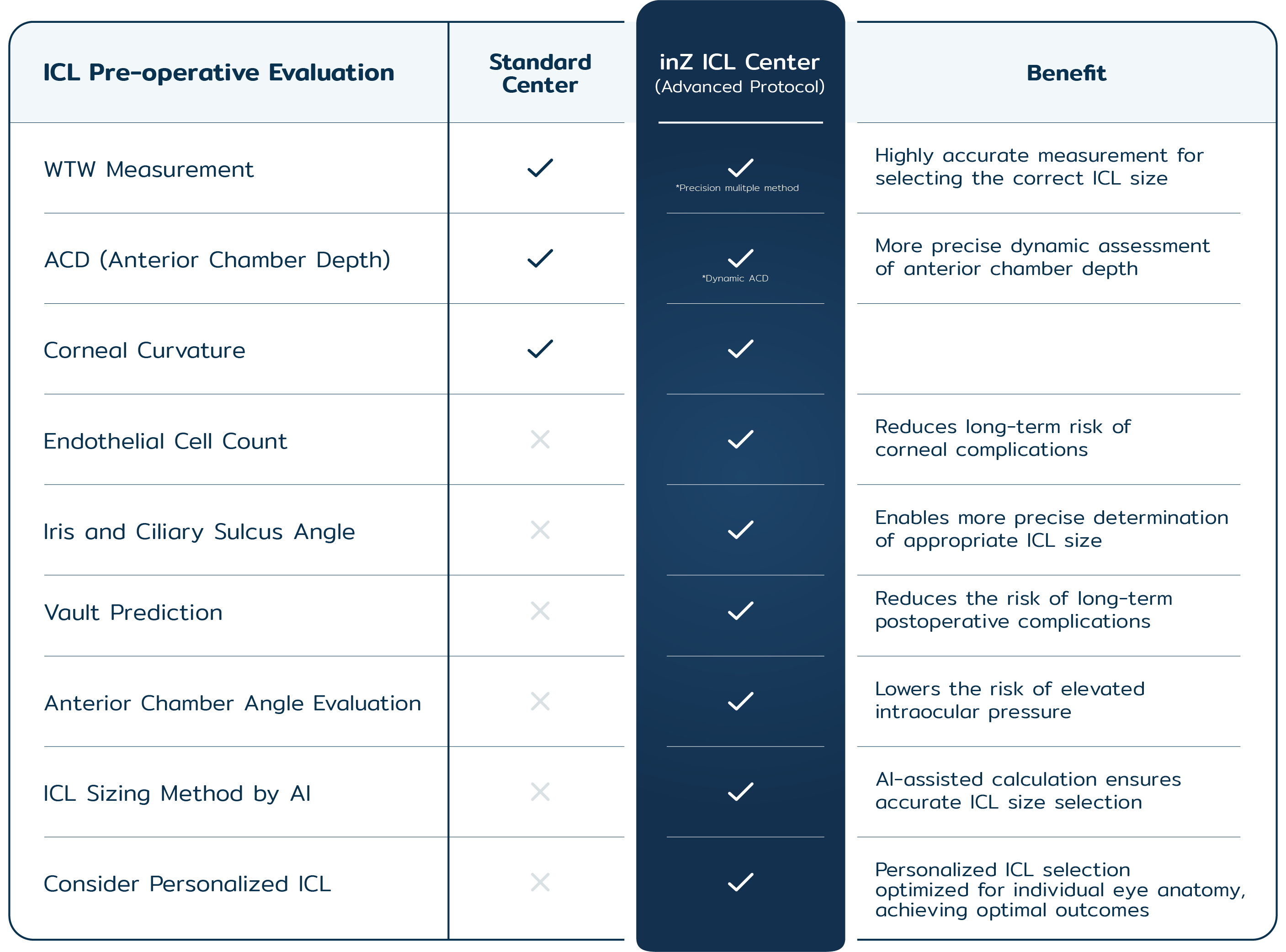
Personalized Sizing Algorithm
This is a crucial step and the key to achieving optimal outcomes with ICL implantation. Selecting the correct ICL size that fits the eye precisely is essential for both safety and long-term success.
At inZ ICL Center, we utilize AI-assisted technology to calculate and select the most accurate ICL size for each individual eye.
Because no two eyes are the same — a lens that fits your eye perfectly is the key to achieving the best results and the highest level of safety.
Safety Standards at inZ ICL Center by Dr. Sukanda

Pre-operative Safety Evaluation Comprehensive eye examinations are performed for every patient prior to surgery.

International-Standard Operating Rooms.

Highly experienced ophthalmologists specializing in cornea and vision correction surgery, with extensive expertise in ICL procedures.

Post-operative Monitoring within 24 Hours.

Ongoing yearly evaluations to monitor outcomes and ensure long-term safety.
Types of ICL Procedures

- Myopic ICL for the correction of nearsightedness
- Toric ICL for the correction of astigmatism
- Personalized ICL customized solutions for special or complex cases
- ICL Exchange / Re-sizing Service for patients who have previously undergone ICL implantation and require lens replacement or resizing
- ICL Check up Program comprehensive eye health evaluations for patients with existing ICL lenses
Types of LASIK Procedures

- SMILE Pro
Small-incision laser vision correction, completed in just 8 seconds - Femto LASIK
Vision correction with a corneal flap created using a laser - LASIK / SBK
Vision correction with a corneal flap created using a blade - PRK
Corrects vision by removing the corneal surface using a laser
Ophthalmologists

Dr. Sukanda Swasdibutra (Dr.Tar)
ว.15674
First Thai Ophthalmologist awarded “Highest volume ICL surgeon in Thailand”
Education
- Medical Degree
- Faculty of Medicine Siriraj Hospital, Mahidol University, Thailand
- Certificate
- Certificate Clinical Fellowship in Excimer Laser Vision Center, Brisbane, Queensland, Australia
- Certificate ICL Surgeon, Portugal
Treatment Outcomes

Excellent post-operative visual outcomes

Minimal side effects

99.4% patient satisfaction rate among those who have undergone ICL implantation
ICL Treatment Process

Consultation
Comprehensive Evaluation

Result Analysis
Personalized Lens Calculation

Custom ICL Lens Ordering
Manufacturing
(1-4 weeks)

ICL Implantation Surgery
10–15 minutes per eye

Follow-up Appointments
1 day, 1 week, 1 month, 3 months, and 6 months
Article
No posts
References
- Packer M. Evaluation of the EVO/EVO+ Sphere and Toric Visian ICL: Six month results from the United States Food and Drug Administration clinical trial. Clinical Ophthalmology. 2022;16:1541-53.
- Kamiya K, Shimizu K, Igarashi A, Kitazawa Y, Kojima T, Nakamura T, et al. Posterior chamber phakic intraocular lens implantation: comparative, multicentre study in 351 eyes with low-to-moderate or high myopia. Br J Ophthalmol. 2018;102(2):177-81.
- Kohnen T. Phakic intraocular lenses: Where are we now? J Cataract Refract Surg. 2018;44(2):121-3.
- Ganesh S, Brar S, Pawar A. Matched population comparison of visual outcomes and patient satisfaction between 3 modalities for the correction of low to moderate myopic astigmatism. Clin Ophthalmol. 2017;11:1253-63.
- Wei R, Li M, Zhang H, Aruma A, Miao H, Wang X, et al. Comparison of objective and subjective visual quality early after implantable collamer lens V4c (ICL V4c) and small incision lenticule extraction (SMILE) for high myopia correction. Acta Ophthalmol. 2020;98(8):e943-e50.
- Vargas V, Alió JL, Barraquer RI, JC DA, García C, Duch F, et al. Safety and visual outcomes following posterior chamber phakic intraocular lens bilensectomy. Eye Vis (Lond). 2020;7:34.
- Packer M. The Implantable Collamer Lens with a central port: review of the literature. Clin Ophthalmol. 2018;12:2427-38.
- Schild G, Amon M, Abela-Formanek C, Schauersberger J, Bartl G, Kruger A. Uveal and capsular biocompatibility of a single-piece, sharp-edged hydrophilic acrylic intraocular lens with collagen (Collamer): 1-year results. J Cataract Refract Surg. 2004;30(6):1254-8.
- Brown DC, Ziemba SL, Collamer IOL FDA Study Group. Collamer intraocular lens: clinical results from the US FDA core study. J Cataract Refract Surg. 2001 Jun;27(6):833-40.