


Vision correction today is no longer limited to a single option. For individuals who wish to reduce dependence on glasses but prefer not to alter the cornea, Implantable Collamer Lens (ICL) has become an important and increasingly popular solution worldwide.
What Is ICL?
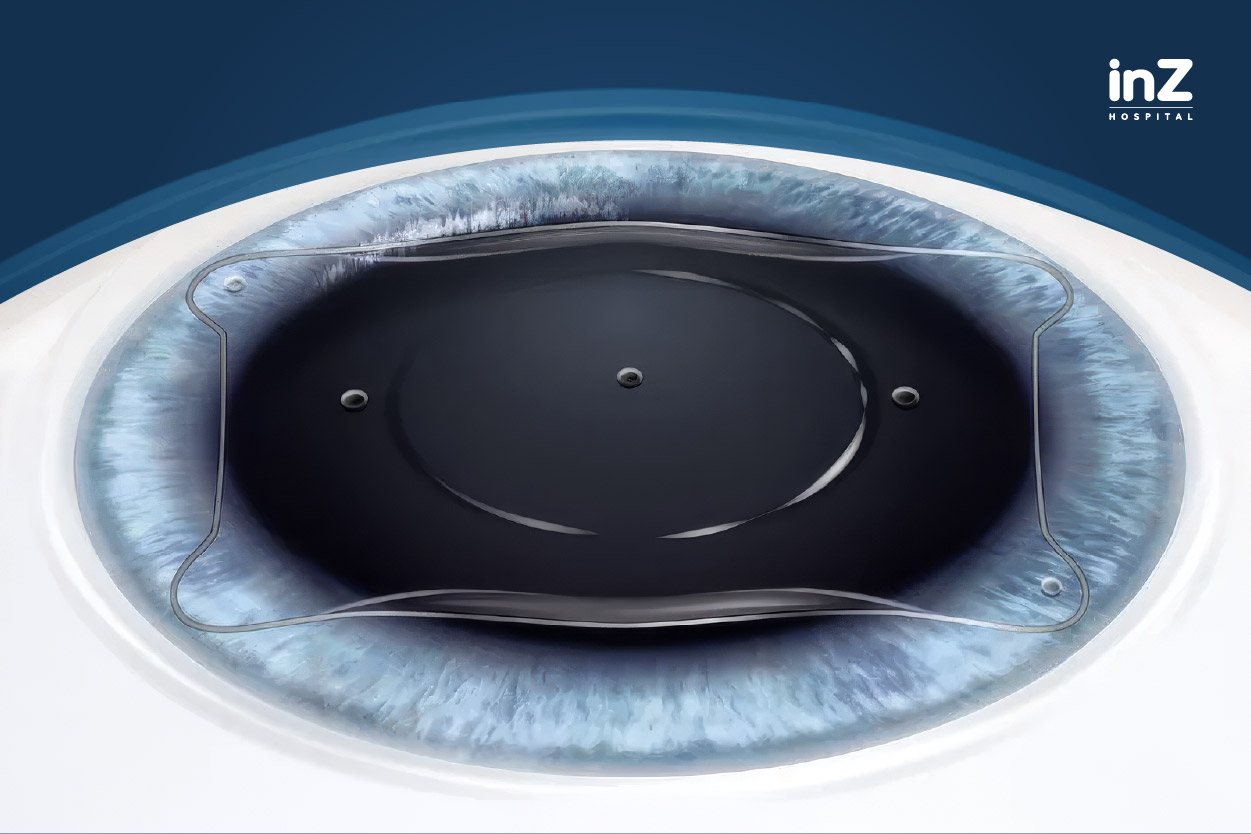
ICL (Implantable Collamer Lens) is a special type of intraocular lens implanted inside the eye.
It is positioned behind the iris and in front of the natural crystalline lens.
- Does not change the corneal structure
- Designed to remain in the eye long term, yet can be removed or exchanged if necessary in the future
- Has been used for more than 30 years, with over 3 million patients worldwide, and continues to grow
ICL can be described as a “permanent contact lens inside the eye” that does not need to be removed daily.
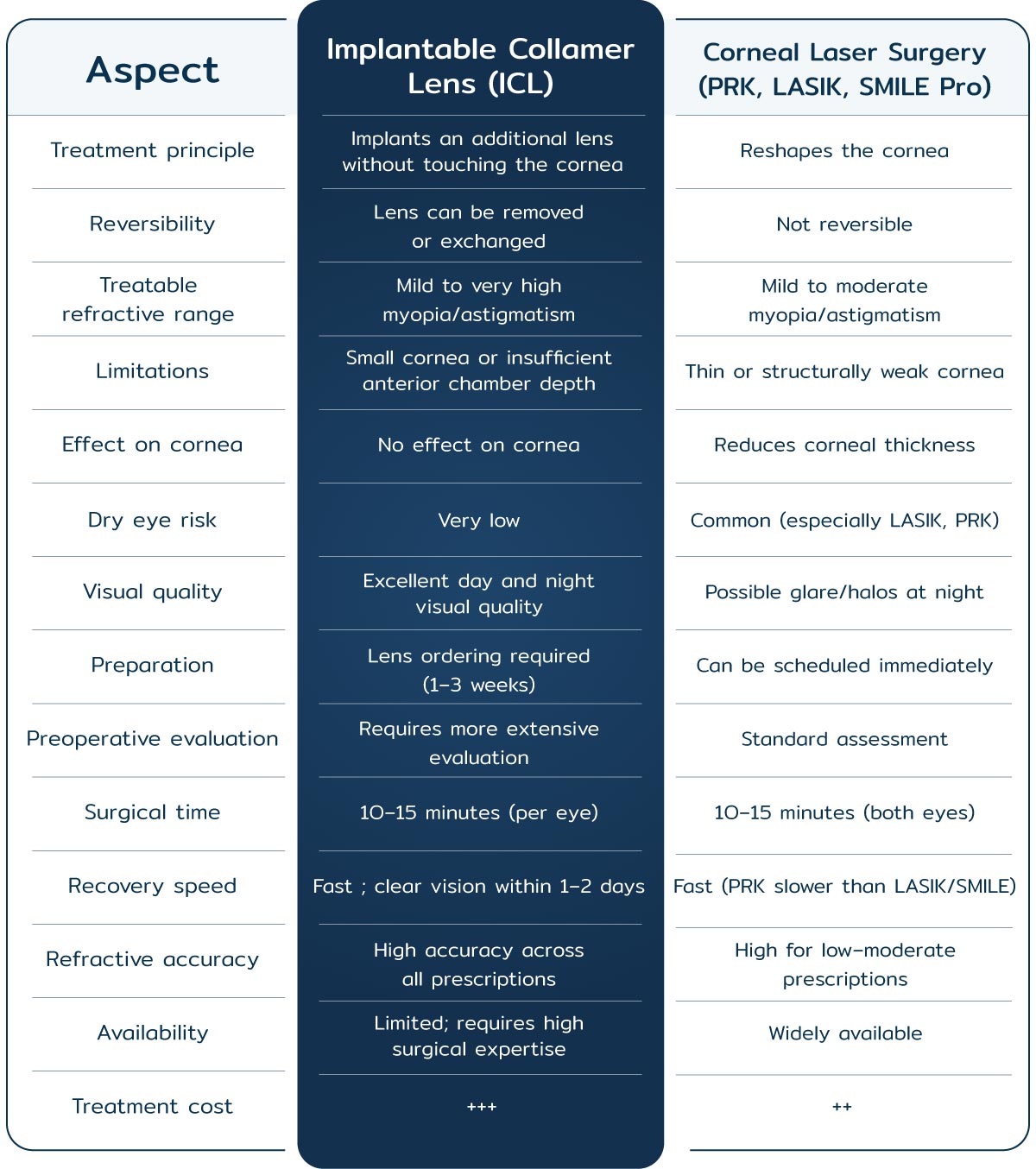
Advantages of ICL
- Does not alter corneal structure; suitable for thin or fragile corneas
- Corrects a wide range of refractive errors, including very high myopia (> −10.00 D)
- Does not worsen dry eye symptoms
- Excellent visual quality: sharp, stable, and high contrast
- Many patients achieve functional vision within 24 hours
- Lens can be removed if needed in the future
Disadvantages of ICL
- Higher cost compared to laser vision correction
- Requires significant surgical expertise to achieve optimal outcomes
- Limited number of experienced ICL surgeons in Thailand
Who Is a Suitable Candidate for ICL?
- Age 21 years or older
- Myopia from −0.75 to −16.00 diopters
- Astigmatism up to −6.00 diopters
A comprehensive eye examination is essential, as not everyone is suitable for ICL.
Visual Outcomes After ICL Implantation
(Visian EVO / EVO+ ICL by STAAR Surgical)
- Rapid recovery; many patients can use their vision within 24 hours
- 87.6% achieve visual acuity of 20/20 or better
- Over 99% achieve functional vision for daily activities without glasses
- High-quality, stable long-term visual outcomes
- Proven safety through global clinical studies and long-term follow-up
- Very low rate of serious complications when performed by experienced surgeons with proper patient selection
Possible Complications of ICL
ICL implantation is considered a highly safe procedure, but as with any medical treatment, potential risks exist, such as:
- Temporary elevation of intraocular pressure
- Suboptimal vision due to inappropriate lens sizing
The most important factor in minimizing risk is thorough preoperative evaluation, which significantly reduces complication rates.
How INZ ICL Center Is Different
- Safety and Advanced Preoperative Evaluation
ICL Pre-operative Evaluation
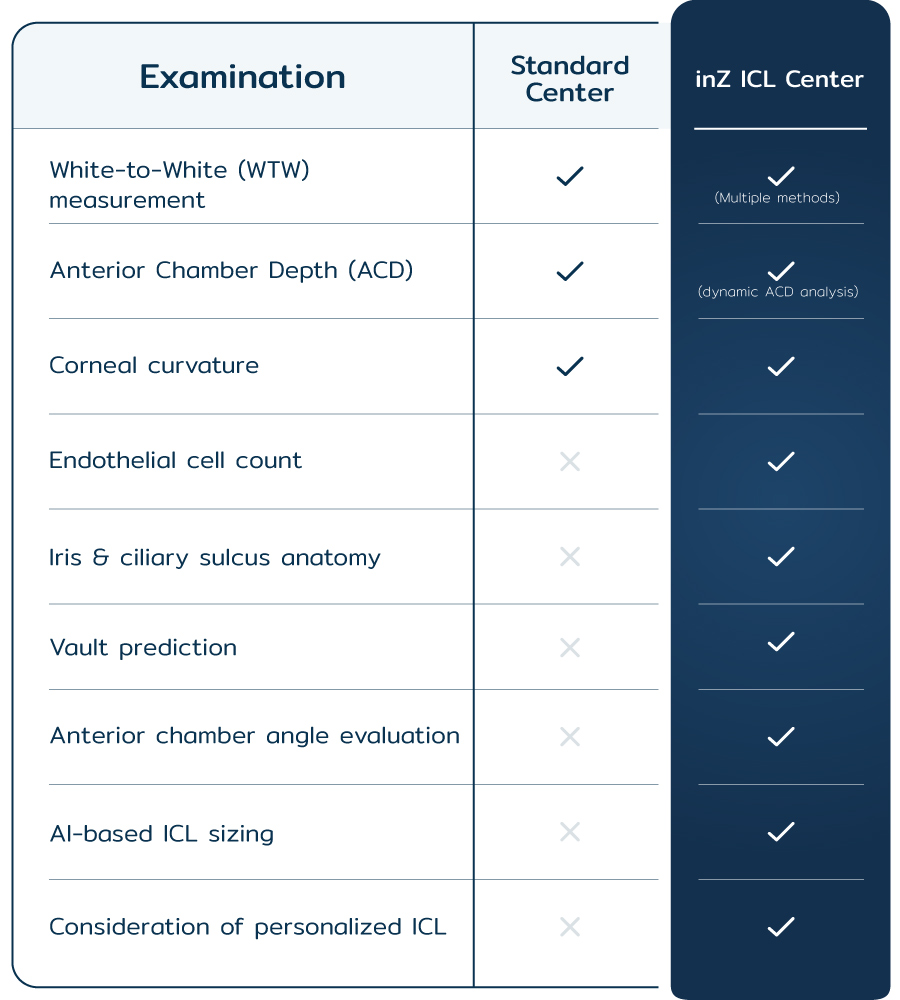
2. AI-Assisted ICL Sizing for Greater Precision
Advanced AI algorithms are used to improve accuracy in lens sizing and outcome prediction.
3. Personalized ICL (Custom-Made ICL)
The key to successful ICL outcomes is accurate lens sizing.
Some patients have ocular anatomy that differs significantly from population averages. In such cases, stock ICL lenses may not provide an ideal fit, as they are designed for the majority.
The solution is custom-designed ICL, tailored specifically to the individual eye.
Dr. Sukanda Swasdibutra (Dr. Tar) is currently the only ophthalmologist in Thailand who routinely orders custom-made ICL lenses, personally designing lens parameters for selected patients.
ICL Today
ICL is no longer only an alternative for patients who cannot undergo LASIK.
It is now a rapidly growing refractive solution worldwide.
In some countries, such as Japan, ICL has become the number one choice for myopic patients seeking freedom from glasses.
Frequently Asked Questions (FAQ)
1. Can I wear contact lenses after ICL implantation?
Yes. Cosmetic contact lenses may be worn after 1 month, once the eye has fully healed.
2. How long does an ICL last?
ICL is designed to remain permanently in the eye. If refractive changes occur or medical indications arise, the lens can be removed or exchanged.
3. How many ICL brands are available, and which is the best?
Currently, the most widely used and clinically validated ICL is Visian ICL (including EVO / EVO+), manufactured by STAAR Surgical.
It is the most extensively studied ICL worldwide, FDA-approved, and supported by robust long-term safety and efficacy data.
While other brands are emerging, Visian EVO / EVO+ remains the gold standard in terms of scientific evidence and global clinical use.
Reference
Packer M. Evaluation of the EVO/EVO+ Sphere and Toric Visian ICL: Six Month Results from the United States Food and Drug Administration Clinical Trial. Clin Ophthalmol. 2022 May 21;16:1541-1553. doi: 10.2147/OPTH.S369467. PMID: 35645557; PMCID: PMC9132105.